[ISAFIS Newsletter #15] COP30: Will Countries Walk the Talk?
Written by: Jonathan Jordan Staff of Research and Development
The 30th United Nations Conference of the Parties (COP30) is being carried out in Belém, Brazil, from November 10 to 21. The multilateral forum is aimed at providing solutions to the threat of climate change. In many ways, the COP30 is unique from previous years. First, it is located in the Amazon rainforest area, one of the most effective mitigation agents of climate change. Second, it highlights indigenous people’s role in tackling environmental issues. Finally, it places greater emphasis on the implementation of climate action by nations around the world. However, behind all of this, there are still problems that hinder the effectiveness of the conference.
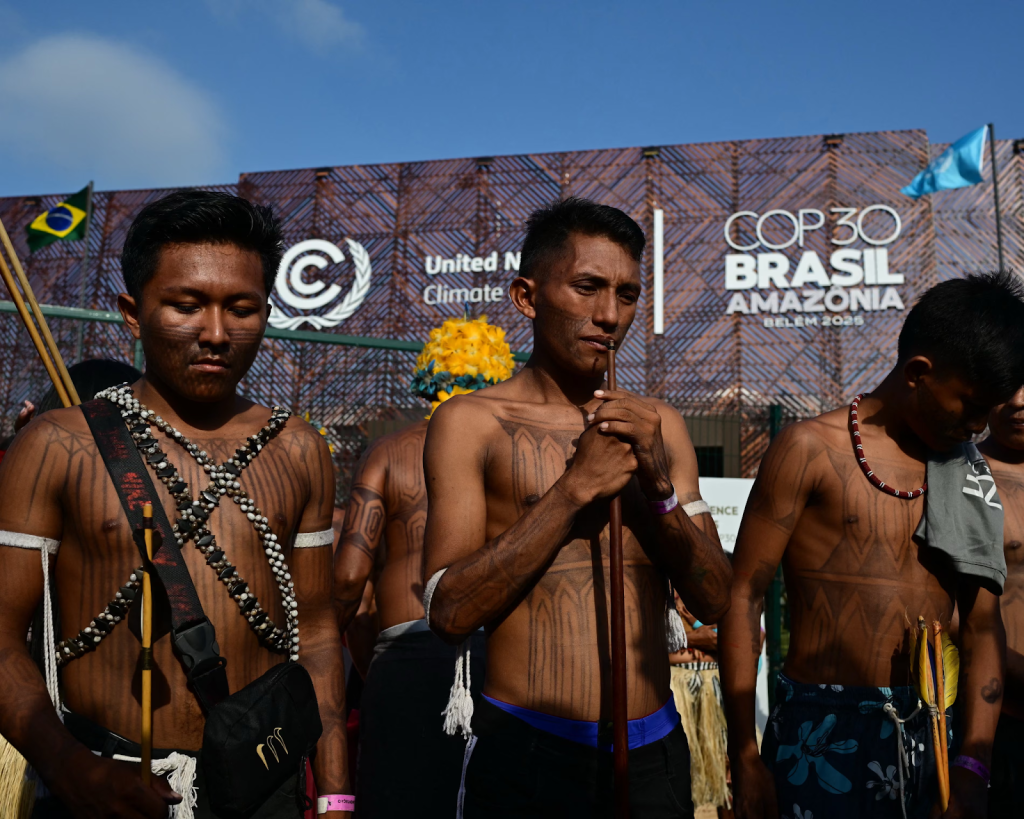
Image 1. People from the indigenous Muduruku tribe protest against infrastructure projects threatening their land at the COP30 entrance in Belém.
Source: Pablo Porcuincula/AFP
What Is the COP?
The COP is a multilateral conference under the United Nations Convention on Climate Change (UNFCC). It aims to construct an international climate action regime. For three decades, the COP has been the main mechanism for advancement in the global mitigation of and response to climate change under the United Nations. The COP is responsible for facilitating the creation of the Kyoto Protocol and Paris Agreement, two major frameworks designed to combat climate change.
However, these initiatives have proven to be quite ineffective. The Paris Agreement’s impact, for example, could be diminished due to its voluntary mechanism. Under the framework, nations must submit nationally determined contributions (NDCs), their national climate action plans. However, these plans often lack effective implementation for reasons such as intentionally weak enforcement and inconsistent policy design, which are political in nature.
Failure of the Previous COPs
Before, the previous COPs did not produce desirable results in fighting climate change. A year earlier, for example, the COP29 in Baku, Azerbaijan, resulted in a disappointing, watered-down compromise between developed and developing countries. In the end, developed nations only had to provide $300 million to developing states to help in combating the climate crisis, a figure far below the $US 1.3 trillion needed as figured by scientists. The hesitance of developed countries to contribute more has exacerbated the gap between countries in addressing climate change. The dominance of ambiguous languages without a clear plan also resulted in low commitment to climate action. A major reason behind this is the lobbying of petrostates, such as Saudi Arabia, who refused the transition from fossil fuels.
In 2023, the COP28 in Dubai, the UAE, also ended in a “dream outcome” for the fossil fuel industry, the opposite of what it was supposed to achieve. Again, it generated an ambiguous agreement that was affected by the interests of petrostates. In addition, the president of COP28, Sultan Al Jaber, claimed there is no science that backed dismantling the fossil fuel industry as a solution to climate change, a statement that was heavily criticized by many scientists.
The Challenges of COP30
These failures all happened against the backdrop of a rising global temperature increase, which rose by 1,6 degrees Celsius in 2024, the first year in which it exceeded the 1,5 degrees Celsius limit. As a result, climate change is causing more devastation than ever before, especially in island and equatorial nations, where the rise of sea levels pose higher threats. This raises the urgency of this year’s COP30 to deliver real results to combat climate change.
However, such an effort is facing several challenges. First, the unprecedented absence of the United States (US), the world’s biggest emitter in terms of historical emissions, weakens its effectiveness due to a decreased scope of potential collective action. From the start of his second term, US president Donald Trump has shown skepticism in climate change. This is evident through his executive order to pull out the US out of the Paris Agreement. As said by White House spokeswoman Taylor Rogers, “President Trump will not jeopardize our country’s economic and national security to pursue vague climate goals that are killing other countries”.
Second, despite its insistence on the role of indigenous peoples, the conference has been criticized by those very groups. These people believe that the COP30 is too much talk and too little action. In their view, leaders don’t take their own interest seriously. If they did, they would’ve done more to mitigate actions that harm their homes and the environment. “We want our lands free from agribusiness, oil exploration, illegal miners and illegal loggers,” said a Brazilian indigenous leader. Controversies raised by the deforestation of the Amazon for a highway in Belém that is popularly associated with the COP30 also caused uproar, along with the use of private jets by lobbyists and billionaires to get to the conference. This dissatisfaction is the reason why Brazilian indigenous tribes stormed the COP30 venue on November 12. Indigenous groups also participated in a wider “Great People’s March” protest to promote stronger climate action.
Third, the greater emphasis in implementation has led to questionable solutions proposed by some states. Indonesia, for example, highly promotes market mechanisms through carbon trading as a solution to climate change. Under the carbon trading mechanism, big polluters can offset their carbon emissions by buying carbon credits from entities that emit less. However, this raises concerns among experts about greenwashing, a phenomenon where an illusion of climate action is created even though polluters haven’t decreased their emissions. Instead of committing to actual climate action, nations use greenwashing techniques to cover up pollution.
Besides those three issues, there are also persistent problems inherited from previous COPs, such as the lobbying of high-emission industries that prevent a stronger action against climate change. These challenges may hinder the aims of COP30, resulting in a watered-down agreement that is not nearly enough to mitigate the climate crisis, much like the previous conferences.
Conclusion
There is much at stake for the world in the COP30. As the world descends into further ecological disaster, strong climate action is increasingly needed. However, the need for change is often denigrated by the challenges that the conference has to face. We have to ask, in the face of climate change, what will countries do? Will they walk the talk or will they simply talk the talk?
Reference
Agencies. (2025, November 17). Death toll from Central Java landslide rises to 18. The Jakarta Post. https://www.thejakartapost.com/indonesia/2025/11/17/death-toll-from-central-java-landslide-rises-to-18.html.
Aranditio, S. (2024, December 3). COP29 Mengecewakan, Bumi Kian Terancam. Kompas. https://www.kompas.id/artikel/cop29-mengecewakan-bumi-kian-terancam.
Barrio, F. F., & Ahmed, I. (2025, November 16). Massive march in Brazil marks first big UN climate protest in years. The Jakarta Post. https://www.thejakartapost.com/world/2025/11/16/massive-march-in-brazil-marks-first-big-un-climate-protest-in-years.html.
Borenstein, S., Delgado, A. L., & Walling, M. (2025, November 11). At UN climate talks in Brazil, the only sign of the United States is an empty chair. The Associated Press. https://apnews.com/article/climate-brazil-trump-disasters-cooperation-cop30-ae09566d32a8a97a954b2cef831de503.
Borenstein, S., Delgado, A. L., & Walling, M. (2025, November 18). Nations hit by natural disasters tell ministers at climate talk to act. The Associated Press. https://apnews.com/article/climate-cop30-brazil-amazon-b0180e585bdee96ae3e00a72e489b8d6.
Brown, F., & Morella, C. (2025, November 5). Typhoon death toll climbs to 66 in the Philippines. The Jakarta Post. https://www.thejakartapost.com/world/2025/11/05/typhoon-death-toll-climbs-to-66-in-philippines.html.
Carrington, D. (2023, December 14). Failure of Cop28 on fossil fuel phase-out is ‘devastating’, say scientists. The Guardian. https://www.theguardian.com/environment/2023/dec/14/failure-cop28-fossil-fuel-phase-out-devastating-say-scientists.
Depledge, J. (2024). The future of negotiations under the climate change COP (Conference of the Parties): Implementation is not enough. Dialogues on Climate Change, 1(1), 12-17. https://doi.org/10.1177/29768659241293212.
Hanung, G. (2025, November 12). ‘Greenwashing’ concerns raised as Indonesia offers carbon trade at COP30. The Jakarta Post. https://www.thejakartapost.com/indonesia/2025/11/12/greenwashing-concerns-raised-as-indonesia-offers-carbon-trade-at-cop30.html.
Hidayat, A. (2025, October 25). Bayang-bayang Greenwashing di Balik Mitigasi Iklim Indonesia. Tempo. https://www.tempo.co/lingkungan/cop30-second-ndc-perdagangan-karbon-2083283.
Mitchel, T. (2024, November 28). A missed opportunity: why COP29’s broken promises will leave billions behind. International Institute for Environment and Development. https://www.iied.org/missed-opportunity-why-cop29s-broken-promises-will-leave-billions-behind.
Nilsson-Julien, E. (2025, November 17). Fact Check: Did Brazil chop down 100,000 trees for COP30? Euronews. https://www.euronews.com/my-europe/2025/11/17/fact-check-did-brazil-chop-down-100000-trees-for-cop30.
Peterson, L., & van Asselt, H. (2025). Assessing risks to the implementation of NDCs under the Paris Agreement. Climate Policy, 1–15. https://doi.org/10.1080/14693062.2025.2513023.
Rowlands, L., & News Agencies. Indigenous activists storm COP30 climate summit in Brazil, demanding action. Aljazeera. https://www.aljazeera.com/news/2025/11/12/indigenous-activists-storm-cop30-climate-summit-in-brazil-demanding-action.
Sherrington, R., & Lakhani, N. (2025, November 18). More than 300 big agriculture lobbyists have taken part in COP30, investigation finds. The Guardian. https://www.theguardian.com/environment/2025/nov/18/big-agriculture-lobbyists-cop30-climate-summit.
Volcovici, V., & Paraguassu, L. (2025, November 17). China finds bigger role as US sidesteps Brazil climate summit. The Jakarta Post, 5.
Walling, M., Borenstein, S., & Delgado, A. L. (2025, November 18). UN climate conference host Brazil urges nations to negotiate and find solutions to global warming. The Associated Press. https://apnews.com/article/cop30-brazil-climate-conference-a64632a868fd0d6f504763f7296d7d0d.
Watts, J. (2025, November 5). ‘A meeting of voices’: flotillas head to Belém ahead of Cop30 climate summit. The Guardian. https://www.theguardian.com/environment/2025/nov/05/a-meeting-of-voices-flotillas-head-into-belem-ahead-of-cop30-climate-summit.
Wells, I. (2025, March 12). Amazon forest felled to build road for climate summit. BBC. https://www.bbc.com/news/articles/c9vy191rgn1o.

0 Comments