[ISAFIS Gazette #15] “Back to Your Country!” Has Anti-Tourist Sentiment Become a Justified Response to Tourist Entitlement?
Written by: Gracelycia Angeline Serat Staff of Research and Discussion
“Sorry for bringing money to your country!” This remark made by an Italian foreign student on a study tour in Bangkok in July 2026 captures a sentiment that is disturbingly familiar across Southeast Asia’s tourist hotspots. This kind of tourist behavior is unfortunately not uncommon; a similar entitlement surfaced a few weeks earlier in Central Jakarta, when a foreigner walked out on his coffee shop bill and justified it by saying, “Because I’m building your country” (Indonesia Expat, 2026). This issue is not a once-or-twice type issue; reports of disrespectful tourist conduct across the region’s most visited destinations—including Southeast Asian nations—have been widely observed to be rising, causing waves of anger from hosts’ residents all over and pushing the rise of anti-tourism. This phenomenon prompts an uncomfortable, yet valid question: has anti-tourist sentiment become a justified response to a deepening pattern of entitlement, rather than mere xenophobia dressed up as activism?
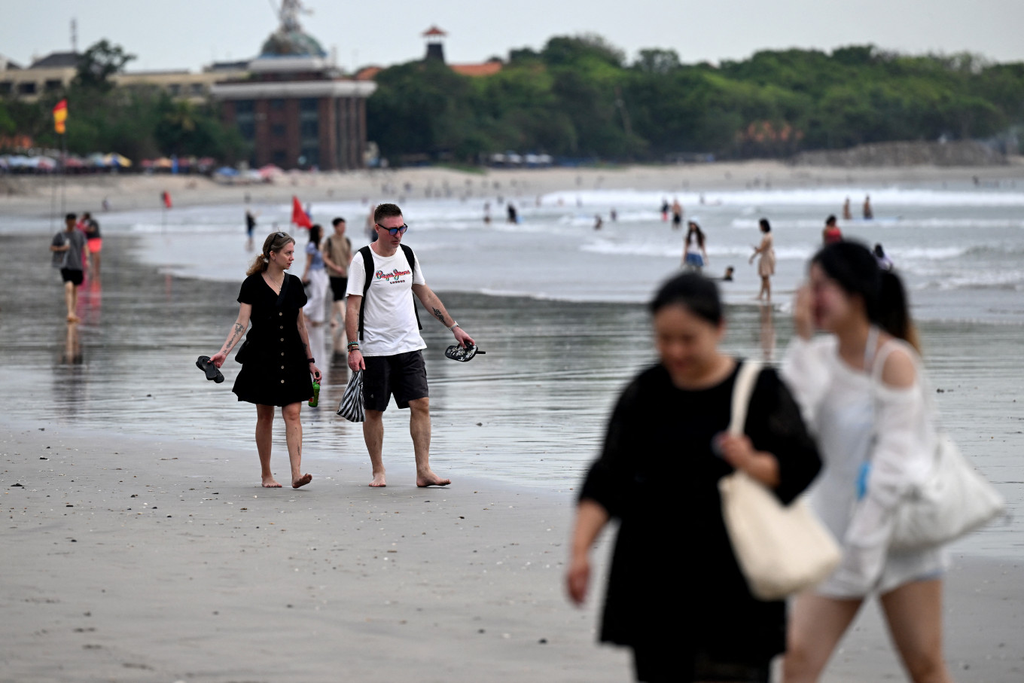
Image 1. Tourists walking along a beach in Kuta, Bali on the 8th of April 2026
Source: AFP/Sonny Tumbelaka
Understanding Anti-Tourist Movements
Anti-tourism can be understood as residents’ social and political opposition to mass tourism, overtourism, and unchecked touristification that strain community resources and lower their quality of life (Milano et al., 2024). Over the years, Southeast Asian nations such as Thailand, Indonesia, and Vietnam have become a hotspot destination for travellers from all over the world, welcoming about 121 million international tourists in 2024 (Rillo et al., 2025). While international exposure via tourism can be an advantage to these countries, it can also be a magnet for bad tourists. Recently, several Southeast Asian countries have done more drastic actions towards bad tourist behavior. As an example, in the first half of 2026 alone, Bali has deported 342 foreign nationals, a steep difference compared to the number of deportation that has been done in 2024 of only 157 deportations (Migrant Times, 2026).
From breaking cultural norms to outright disrespectful, even discriminatory behavior, it is no surprise that these types of behavior spark local anger, even advocating for foreigners as a whole to be given less access to these destination places. One prominent example of this activism in Southeast Asia is one held by the Thai Mai Thon (Thais Won’t Tolerate It) group. On 24th of August 2026, the activist group submitted a letter outside the Israeli Embassy urging Israeli tourists to respect the country’s laws, customs, and culture upon receiving reports of intimidation, harassment, and disputes involving Israeli nationals. It is important to note that the group stressed that they do not intend to generalise about Israeli people and instead advocate that anyone who violates Thai law should be investigated and prosecuted through legal process (Khaosod English, 2026) .
The Thai Mai Thon is not the only form of activism that advocates for tourist accountability; other Southeast Asian nations have also taken action to advocate for this cause as more cases of disrespectful tourist behavior emerged. These cases have brought concerns surrounding tourist entitlement to the forefront of regional discourse. As cases arise from one region to another, taken together, they suggest that the behavior driving anti-tourism across Southeast Asia is not targeted at a single nationality or destination, but a pattern that keeps happening across the region.
Tourist’s Postcolonial Mindset
These recurring patterns can be rooted in two reasons: (i) the sense of financial superiority and (ii) the “tourist gaze” concept. Foreign tourists’ sense of superiority is displayed through remarks that are made, especially ones involving financial superiority. One thing that many of these cases have in common is the justification used by tourists to defend their actions under the premise of building the host country’s economy. The justifications are not just mere words out of carelessness, but a highlight of an underlying assumption that the host economy is dependent on, and therefore beholden to, the tourist’s presence and expenditure. In the case of Southeast Asian nations, according to the ASEAN 2025 Tourism Outlook, the travel and tourism sector contributes to 9.7% of ASEAN’s GDP, or equivalent to US$ 379 billion (Rillo et al., 2025). These numbers display the significant economic reliance of these countries on the tourism industry, as tourism allows job creation and the development of local economies across Southeast Asian nations. Another attribute to tourists’ financial superiority perception is the currency disadvantage that several Southeast Asian countries have, meaning that prices in these countries are relatively lower than the home countries from which these tourists came, further expanding this financial superiority perception.
Another reason we can attribute this behavior to is the sociological concept of “tourist gaze” stated by John Urry (2002). The tourist gaze can be understood as a concept that explains that travellers’ perceptions of travel destinations are not neutral and are socially constructed by culture, media, society, and even their own personal upbringing. Humans have a strong tendency toward familiarity; these familiarities include norms, rules, and standards by which they are raised. Following this assumption, foreign tourists—when visiting a foreign country—subconsciously perceive and approach their destination with the expectation of familiarity; hence, they act and behave in accordance with their perception.
When putting these two factors together, we can conclude that foreign tourists who behave in accordance with their expectations might not behave in accordance with the norms set by residents. Furthermore, when residents remind or confront these tourists, tourists with a sense of financial superiority defend themselves using comments downplaying host countries’ economic condition—displaying their postcolonial mindset of superiority, in this case, in Southeast Asian countries with relatively weaker economies than their home countries.
Host Countries are Pushing Back
With the increase in disrespectful tourist behavior, one thing is certain: it is time for countries to push back. Local governments have made stricter regulations and consequences for disrespectful tourist behavior. One recent example includes the arrest of a 26-year-old tourist in Bali on 19th of March 2026, after the tourist recorded a video using obscene language to insult Nyepi and the norms surrounding it. After his video went viral, the tourist was then charged under Article 301 (1) of Indonesia’s new Criminal Code, and prosecutors demanded a 15-month prison sentence against him. (Indonesia Investments, 2026) Additionally, the case of the Italian students’ rude behavior in Thailand showed that host countries are not alone in managing disrespectful tourist behavior. Instead, tourists’ home countries could also step in to address the issues and press accountability for their citizens’ actions. Through its official Facebook page, on Saturday, 25th of July, the Italian embassy expressed its deep regrets and strongly condemned the students’ inappropriate behavior (Ajanapanya, 2026; France 24, 2026; The Straits Times, 2026). Additionally, attached to the embassy’s statement was a 95-second video featuring 4 of the students apologising to the Thai public. Additionally, Thai police charged each person with a fine of 1,000 baht (S$38) for insulting another person in their presence. Besides immediate government intervention towards addressing existing rude tourist behavior, Thailand’s government has also made efforts to mitigate the rise of these cases through their policies. For instance, it has posted a warning, mentioning that “problematic” tourists could face deportation if convicted of illegal activities (AFP, 2026).
The Limits of Hospitality
Back to the question, are anti-tourist sentiments something that is justified? The recurring patterns of rude remarks, disproportionate justifications for disrespectful behaviors, and the obvious sense of superiority of foreign tourists are more than enough reasons to understand that anti-tourism in Southeast Asia is more of a proportionate response to a recurring pattern of entitlement. Southeast Asia has been known as a region with great hospitality on top of their famous vacation destinations. However, treating that hospitality as a sign of welcome to disrespect cultural norms and regulations isn’t something that locals should stay silent about. It is important to understand that anti-tourist sentiments do not exist as a form of discrimination or xenophobia, but a defense and protective action against threats to the norms that have been set by residents of the host countries. If locals choose to remain silent as they endure disrespect from travellers, standards might change, and that change might be the reason for the destruction of these host countries, as it may ruin the charm that makes these countries inviting in the first place.
References
AFP. (2026, August 28). Southeast Asia’s second most visited country warns “problematic” tourists could face deportation. VnExpress International. https://e.vnexpress.net/news/travel/visa/southeast-asia-s-second-most-visited-country-warns-problematic-tourists-could-face-deportation-5114817.html
Ajanapanya, N. (2026, July 25). Italian embassy issues apology after Italian youth group sparks fury on Bangkok train. The Nation. https://www.nationthailand.com/news/general/40069041
France 24. (2026, July 25). Italian embassy, teen apologise after viral Bangkok train dispute. https://www.france24.com/en/live-news/20260725-italian-embassy-teen-apologise-after-viral-bangkok-train-dispute
Indonesia Expat. (2026, June 2). Foreigner refuses to pay coffee shop bill in central Jakarta, claims he ‘built’ Indonesia. https://indonesiaexpat.id/news/foreigner-refuses-to-pay-coffee-shop-bill-in-central-jakarta-claims-he-built-indonesia/
Indonesia Investments. (2026, July 13). Swiss tourist faces 15 months in Bali Jail over nyepi video. https://www.indonesia-investments.com/culture/culture-columns/the-price-of-disrespect-a-swiss-tourist-s-hard-lesson-in-bali-s-sacred-silence/item9982
Khaosod English. (2026, August 25). Thai group gathers at Israeli Embassy over tourist behavior. https://www.khaosodenglish.com/news/2026/08/25/thai-group-gathers-at-israeli-embassy-over-tourist-behavior/
Migrant Times. (2026, July 7). Bali immigration deports 342 foreign nationals. https://migrantimes.com/law-justice/06-07-2026/bali-immigration-deports-342-foreign-nationals
Milano, C., Novelli, M., & Antonio Paolo Russo. (2024). Anti-tourism activism and the inconvenient truths about Mass tourism, touristification and overtourism. Tourism Geographies, 26(8), 1–25. https://doi.org/10.1080/14616688.2024.2391388
Rillo, A. D., Carvao, S., Ruescas, J., Julian, M., Kumar, P., Rodak, F., Torres, I., Chopin, C., & Conilleau, J. (2025). ASEAN Tourism Outlook 2025. ASEAN Secretariat. https://asean.org/book/asean-tourism-outlook-2025/
The Straits Times. (2026, July 26). Italian students who sparked outcry over bad behaviour on Bangkok train apologise following fines. https://www.straitstimes.com/asia/se-asia/italian-students-who-sparked-outcry-for-bad-behaviour-on-bangkok-train-apologise-following-fines

0 Comments