[ISAFIS News #21] UN Moves Beyond Mercator to Reflect Africa’s True Size
Written by: Putu Devi Savitri Staff of Research and Discussion
On September 4th, 2026, the United Nations General Assembly adopted a resolution that changed the world map to reflect Africa’s true size. Championed by Togo on behalf of the African Union, the non-binding ruling is meant to replace the commonly-used Mercator projection with the Equal Earth model.
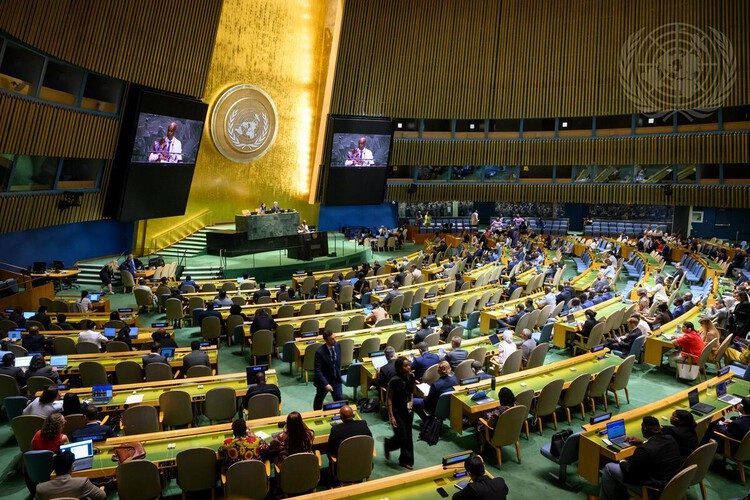
Image 1. United Nations General Assembly voting on adopting the Equal Earth projection on September 4th, 2026.
Source: UN Photo/Loey Felipe
The Mercator projection, developed in 1569 by Flemish cartographer Gerardus Mercator, was designed to support European maritime navigation. While effective for that purpose, it inflates the size of landmasses farther from the equator while shrinking those nearer it, particularly Africa. Under Mercator’s projection, Greenland looks roughly equal in size to Africa even though the continent is in reality about fourteen times larger.
The campaign gained institutional momentum in March 2026, when the African Union (AU) formally adopted the Equal Earth projection, a balanced equal-area map developed in 2018, as its preferred cartographic standard. Togo carried the initiative to the UN on the AU’s behalf, leading to months of consultation before the resolution reached a vote.
Introducing the resolution, Togolese Foreign Minister Robert Dussey argued that maps shape how people understand the world. “A fair map,” he said, “does not change the geography of the world, it changes how we see the world.” The resolution frames the correction as a matter of “cognitive justice and memorial reparation” for Africa’s symbolic minimisation across media, education, and policymaking. As AU Commissioner Amma Twum Amoah put it, the campaign is about Africa “being seen at its true scale, geographically, historically, morally, culturally, economically, diplomatically and globally”.
The resolution is deliberately measured in its scope. It is not legally binding, does not ban the Mercator projection and mandates no single replacement, leaving actual adoption to the discretion of individual governments, schools, and publishers. As with many UN General Assembly resolutions, its influence will likely depend less on legal force than on normative pressure, whether institutions choose to follow it out of political or reputational considerations, not obligation.
However, support was not unanimous. Out of a total of 171 voters, 161 voted in favour, six abstained, and one was against. The United States cast the sole opposing vote, dismissing the initiative as a “radical ideological project”. Ukraine abstained despite supporting the resolution’s underlying aim, citing concern that some versions of the Equal Earth projection depicted Russian-occupied Ukrainian territory in a “wholly unacceptable” way. It also warned that endorsing the projection without safeguards could open a “Pandora’s box” over the mapping of disputed territories.
References
Bright, J. (2026, September 4). The U.N. backs a new world map showing Africa in its true relative size. NPR. https://www.npr.org/2026/09/04/nx-s1-5958611/africa-world-map-un-vote
Everett, M. (2026, September 4). UN votes to adopt new world map that reflects Africa’s true size. Al Jazeera. https://www.aljazeera.com/news/2026/9/4/un-votes-to-adopt-new-world-map-that-reflects-africas-true-size
Monmonier, M. (2004). Rhumb Lines and Map Wars: A Social History of the Mercator Projection. University of Chicago Press.
Orie, A. (2026, September 4). UN votes to adopt new map that makes our world look very different. CNN. https://www.cnn.com/2026/09/04/world/un-vote-new-world-map-intl-scli
Santos, E. A. (2026). UN New World Map: Legal Effect of the Equal Earth Resolution. Diplomacy and Law. https://www.diplomacyandlaw.com/post/un-new-world-map-legal-effect-of-the-equal-earth-resolution
UN News. (2026, September 4). UN tells the world: Stop making Africa look small. https://news.un.org/en/story/2026/09/1168284
United Nations. (2026, September 4). General Assembly adopts text to ‘Correct the map,’ among others proclaiming Decade of Culture for Sustainable Development, Child Marriage Elimination Day. https://press.un.org/en/2026/ga12779.doc.htm

0 Comments