[ISAFIS Gazette #16] “Forgive Us” or “We Send Oxygen”? Who Is the “Us” in the Haze?
Written by: Putu Devi Savitri Staff of Research and Discussion
“Forgive us” these two words headlined a South China Morning Post report on 15 October 2026, which described how Indonesians called on Singapore and Malaysia to take action against Jakarta as haze spread across the region (Lim, 2026). Days earlier, the head of Indonesia’s Government Communications Agency, Syahganda Nainggolan had told the neighbours that the fires were “beyond human error” and “truly nature”, also adding, “We do not just send smoke; when there is no smoke, we send oxygen” (Jong, 2026). One message asks for forgiveness, while the other denies the need for it. Both are described as Indonesia’s voice.
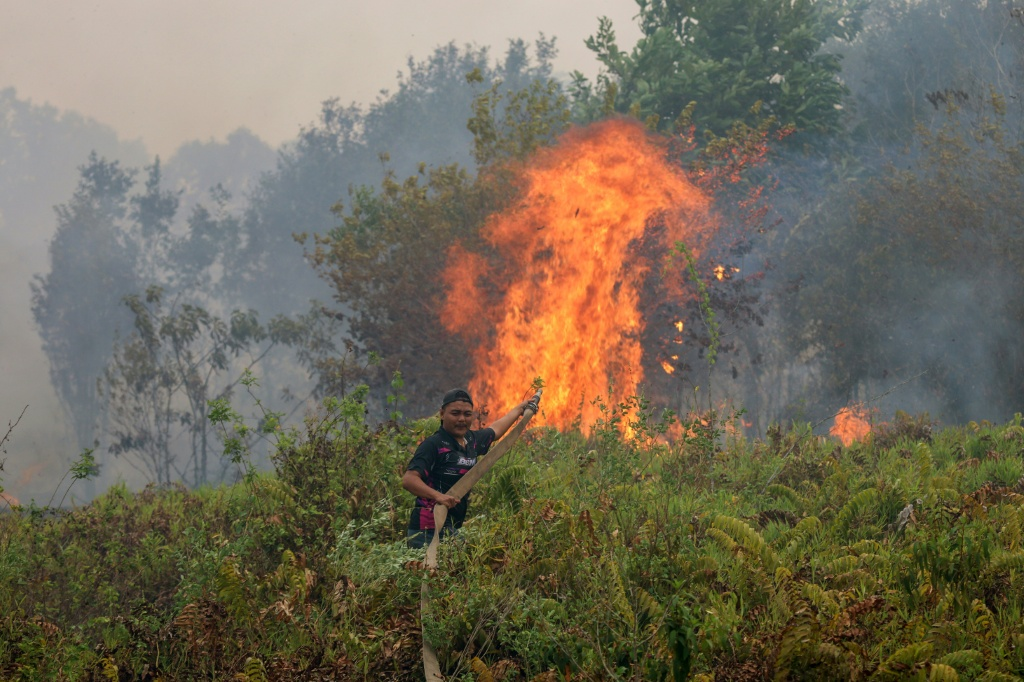
Image 1. A firefighter extinguishing a fire at Sungai Tabuk Village in Kalimantan on 16 October 2026
Source: AFP/Muda Sagala
This article argues that the haze exposes a gap between the Indonesian state and the nation and that the state does not represent its people. This matters for international studies because regional haze is usually framed as a dispute between countries as if each country spoke with one voice. Here, the pemerintah and the bangsa are saying different things, resulting in the serumpun (shared kinship of the Malay world) being expressed more by citizens than by officials.
State and Nation: A Distinction Worth Keeping
The state is the political apparatus that governs a territory and exercises authority over its population. Weber (1946) defined it as “a human community that (successfully) claims the monopoly of the legitimate use of physical force within a given territory”. The nation, by contrast, is a community formed through a shared sense of belonging. Anderson (2006) called it as “an imagined political community” that is “inherently limited and sovereign”, bound by a collective identity even among people who will never meet. The state acts through official statements, permits and legal notices, while the nation expresses itself through the diverse, sometimes also conflicting voices of its people. And when these voices diverge, responsibility for the haze cannot be understood through governments alone.
The State: How Jakarta Enables and Downplays the Burning
The state’s role begins with enabling conditions. WALHI (2026), an Indonesian environmental group, counted about 30,927 hotspots between January and September 2026, nearly half within forestry and oil palm concessions. Its argument extends beyond who started the fires to who failed to prevent them through permits issued on peatlands, weak oversight and weak law enforcement. In Merauke, 674 of 807 hotspots were located in areas directly managed by Indonesian ministries, placing the state in the position of land manager rather than mere bystander. WALHI also identified five businessmen it described as close to President Prabowo Subianto who held roles in three permit-holding companies with high-confidence hotspots. It raised this as a governance ethics concern, not an allegation of personal wrongdoing (WALHI, 2026).
The second pattern is downplaying. The oxygen remark and the claim that the fires were “truly nature” illustrate how public messaging can shift attention away from governance. Natural conditions do play a part, since Reuters (2026) described the season as Indonesia’s most intense El Nino fuelled wildfire season in 11 years. Yet climate conditions alone cannot explain who issued permits for the land where fires occurred. Prabowo’s figures also drew scrutiny. He said the burned area had fallen from “hundreds of thousands of hectares a few weeks ago” to “below 1,000”, but the disaster agency and Forestry Ministry later clarified that this figure covered only areas where firefighters were operating, not the total area burning (Jong, 2026). By 16 October, no Indonesian official had issued a public apology, while Jakarta said foreign assistance had “not yet” been discussed (Jong, 2026; The Straits Times/ANN, 2026).
This does not mean the state took no action. Prabowo called the fires “a top priority for us” and ordered additional firefighting resources (Reuters, 2026). The concern lies in the contrast between operational efforts and public communication that minimised the scale of the crisis, alongside limited accountability for permit governance.
The same argument cannot be made as easily about Singapore and Malaysia. Singapore’s government announced that its National Environment Agency would issue preventive measure notices to seven Indonesian companies under the Transboundary Haze Pollution Act (Bernama, 2026). Then, Malaysia’s government offered aircraft, helicopters and personnel to assist with firefighting (The Straits Times/ANN, 2026). Corporate connections nevertheless cross borders. WALHI (2026) linked at least 93 of 372 reported companies to Malaysia or Singapore, but that is a question of corporate ownership and it does not show that either neighbouring state shaped the fires. Indonesia remains at the centre of this issue, given its authority over the land, permits and enforcement measures that shape fire prevention.
The Nation: Suffering, Demanding and Apologising
When the state minimises the crisis, the nation bears its consequences. By 13 October, 283,270 cases of acute respiratory illness had been recorded across seven provinces (Jong, 2026). Kristaen Albert, a software engineer in Central Kalimantan, described the government’s response as “incredibly slow” (Lim, 2026). These reactions reveal a gap between the state’s management of the crisis and the people’s lived experience of it.
Citizens are also demanding that the government answer for its response. The resident quoted in the South China Morning Post is not apologising so much as being furious, stating, “To put it bluntly, we are angry” (Lim, 2026). The same report describes Indonesians urging Singapore and Malaysia to take action against Jakarta (Lim, 2026). This appeal carries particular significance. Citizens are turning outward not to blame another country, but to seek external pressure on their own government, suggesting that they do not consider official channels sufficient to address their concerns.
Some are apologising to neighbouring countries. RMOL reported a movement of Indonesian netizens collectively apologising to the Singaporean public (Aristama, 2026). And under an Instagram post by Ehsan, a character from the Malaysian animated series Upin & Ipin, joking that haze season had cut short his jogging, Indonesian users wrote, “Minta maaf ya Intan Payung, maaf sangat” (Mutmainah, 2026). These apologies are not acts of state responsibility, since the citizens expressing remorse neither started the fires nor issued the permits that allowed them to burn. Read through serumpun, an apology works to maintain positive relationship rather than an admission of legal fault. Where the state has left a relational gap with its neighbours, citizens try to bridge it themselves.
This interpretation has limits and Indonesians themselves disagree about it. Communication lecturer Adde Oriza Rio warned that “sympathy for victims can be read as an admission that the Indonesian nation is collectively guilty, also that apologies may shift attention away from demands for accountability” (Aristama, 2026). Moreover, vocal online users cannot represent an entire nation and no available data establish how widely these sentiments are shared. Nor is the divide between public and official responses new. President Susilo Bambang Yudhoyono apologised for the haze in 2013 (Al Jazeera, 2013), whereas in 2015 Vice President Jusuf Kalla argued that neighbouring countries “enjoyed clean air from Indonesia and they never thanked us” (Javadi & Han, 2015). Official responses have therefore varied across administrations, but the tension between government rhetoric and citizens’ regional relationships persists.
What the Nation Can Do
If the state will not answer for its actions, the burden shifts to the nation. The first task is to demand accountability through evidence rather than scapegoating. WALHI’s mapping of concessions, owners and hotspots shows what citizen-led scrutiny can look like. Indonesia ratified the ASEAN Agreement on Transboundary Haze Pollution on 20 January 2015, becoming the last ASEAN member to do so (ASEAN, 2015). The regional framework is already in place, and civil society can continue to question why its provisions have not translated into stronger accountability for powerful business groups.
The second task is to build solidarity across borders. On 4 September, Greenpeace Malaysia and Himpunan Advokasi Rakyat Malaysia (HARAM), joined 16 other organisations, protested outside the Indonesian embassy in Kuala Lumpur. Their message was explicit: “This protest is not about blaming Indonesia for the haze” and “The haze does not stop at Indonesia’s borders, and neither should accountability” (Greenpeace Malaysia, 2026). HARAM’s chairman also expressed solidarity with “the communities in Indonesia who are affected by these fires” (Greenpeace Malaysia, 2026). Indonesian civil society can build on this solidarity by sharing data, coordinating campaigns and demanding transparency about the companies linked to the fires, regardless of where they are registered.
The third task is to resist turning governance failures into judgements about entire peoples. Ridicule across the border can harden into stereotypes of Indonesians and that serves neither side. The consequences are felt most directly at home, where air quality in West and Central Kalimantan has remained in the unhealthy to hazardous range (WALHI, 2026). Serumpun must therefore mean more than shared kinship; it must entail shared responsibility. When official responses fail to reflect citizens’ concerns, people can speak for themselves and engage directly with their neighbours across borders.
REFERENCES
Al Jazeera. (2013, June 25). Indonesian president apologises for haze. https://www.aljazeera.com/news/2013/6/25/indonesian-president-apologises-for-haze
Anderson, B. (2006). Imagined communities: Reflections on the origin and spread of nationalism (Rev. ed.). Verso.
Aristama, F. (2026, October 26). Dosen UKI: Warganet tak perlu minta maaf ke Singapura soal karhutla. RMOL. https://rmol.id/politik/read/2026/10/26/726301/dosen-uki-warganet-tak-perlu-minta-maaf-ke-singapura-soal-karhutla
ASEAN. (2015, January 20). Indonesia deposits its instrument of ratification of the ASEAN Agreement on Transboundary Haze Pollution. ASEAN Haze Portal. https://hazeportal.asean.org/?p=2655
Bernama. (2026, October 17). Singapore targets seven Indonesian firms as haze worsens, air quality turns “very unhealthy”. Malay Mail. https://www.malaymail.com/news/singapore/2026/10/17/singapore-targets-seven-indonesian-firms-as-haze-worsens-air-quality-turns-very-unhealthy/239398
Greenpeace Malaysia. (2026, September 4). Civil societies demand transparency and cross-border corporate accountability on haze at Indonesia embassy. https://www.greenpeace.org/malaysia/press/84128/civil-societies-demand-transparency-and-cross-border-corporate-accountability-on-haze-at-indonesia-embassy/
Javadi, T., & Han, D. G. X. (2015, October 9). Clearing the diplomatic haze: Indonesia’s tense ties with Singapore and Malaysia (RSIS Commentary No. 211). S. Rajaratnam School of International Studies. https://rsis.edu.sg/rsis-publication/rsis/co15211-a-new-series-clearing-the-diplomatic-haze-indonesias-tense-ties-with-singapore-and-malaysia/
Jong, H. N. (2026, October 16). ‘Perpetuating stupidity’: Indonesia comes under fire for response to burning and haze. Mongabay. https://news.mongabay.com/2026/10/perpetuating-stupidity-indonesia-comes-under-fire-for-response-to-burning-and-haze/
Lim, K. (2026, October 15). ‘Forgive us’: Indonesians urge Singapore, Malaysia to sue Jakarta over haze. South China Morning Post. https://www.scmp.com/week-asia/health-environment/article/3370998/indonesians-urge-singapore-malaysia-sue-jakarta-haze-blankets-region
Mutmainah, J. (2026, October 19). Ehsan Upin Ipin sindir kabut asap, warganet Indonesia ramai-ramai minta maaf. MalangTIMES. https://malangtimes.com/amp/baca/3331352192/20261019/181700/ehsan-upin-ipin-sindir-kabut-asap-warganet-indonesia-ramai-ramai-minta-maaf
Reuters. (2026, October 13). Indonesia’s Prabowo orders more resources to fight wildfires as haze anger grows. The Star. https://www.thestar.com.my/news/world/2026/10/13/indonesia039s-prabowo-orders-more-resources-to-fight-wildfires-as-haze-anger-grows
The Straits Times/Asia News Network. (2026, October 13). Prabowo orders tougher action on Indonesia fires; foreign offers to help tackle haze not discussed. The Star. https://www.thestar.com.my/aseanplus/aseanplus-news/2026/10/13/prabowo-orders-tougher-action-on-indonesia-fires-foreign-offers-to-help-tackle-haze-not-discussed
WALHI. (2026). Actor Mapping Analysis: Who Are Behind the Fires? Tracing the Capital, Power, and Business Group Affiliations Behind the Companies with the Highest Indications of Forest and Land Fires. Eksekutif Nasional WALHI. https://www.walhi.or.id/uploads/WALHI%202025-2029/Dokumen/%28English%20Version%29%20Actor%20Mapping%20Forest%20and%20Land%20Fires%202026%20-%20Eksekutif%20Nasional%20WALHI%20%28CA%29.pdf
Weber, M. (1946). Politics as a vocation. In H. H. Gerth & C. W. Mills (Eds. & Trans.), From Max Weber: Essays in sociology (pp. 77–128). Oxford University Press.

0 Comments