[ISAFIS Gazette #12] The “Perpetual” Cycle: Gendered Violence in Sudan and the Democratic Republic of Congo
Written by: Madeline Ionna Amabel Sirait Staff of Research and Discussion
Sexual violence does not simply finish when the act has been carried out. It does not erase itself once skin has been rid of marks. Instead, the abuse is tethered, marked, and engraved—carried by victims long after the act itself has been deemed complete. This violence is then rendered obscure, unintelligible, and swallowed whole, by the sheer magnitudes of war.
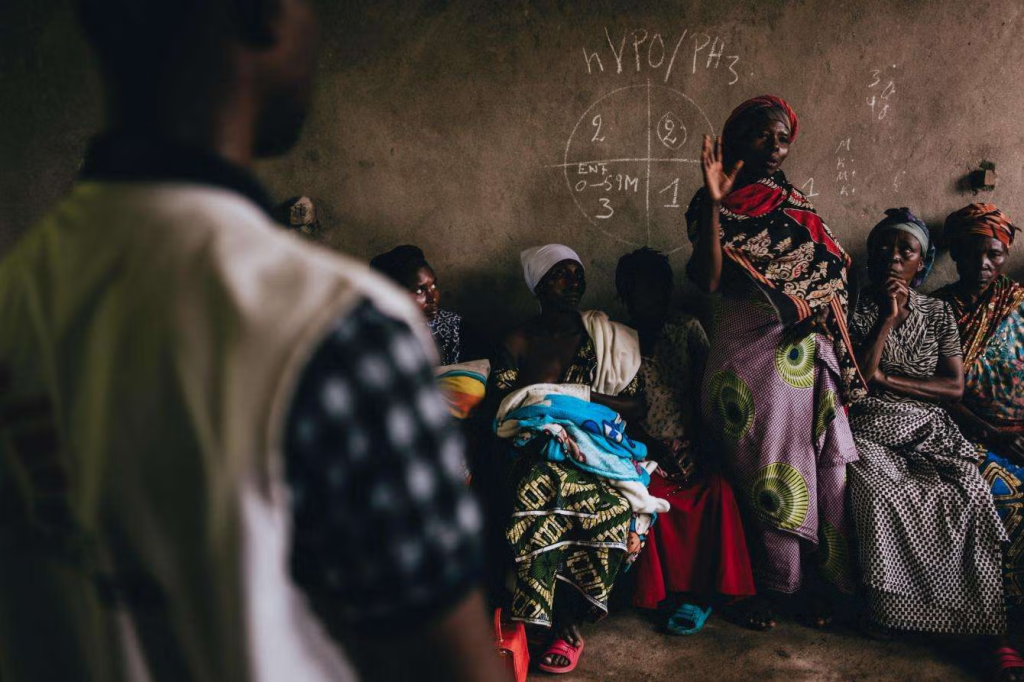
Image 1. Displaced community members who have fled the M23 conflict speak during an awareness-raising session on sexual violence organised by MSF at Kishinji Health Center
Source: Médecins Sans Frontières (MSF) / Hugh Cunningham
Obscurity, however, does not mean absence. In 2025, the United Nations verified 9,788 cases of conflict-related sexual violence worldwide, a figure the organisation admits is only a fraction of the true scale on the ground. Among that number, the Democratic Republic of Congo recorded the highest verified numbers in the world, while in Sudan, 135 amidst 679 documented cases have left survivors in besieged villages so without recourse that they’ve taken their own lives rather than continue living what has been inflicted upon them.
What these numbers reveal, harrowing as they are, is a cycle laid bare: Sudan, where identity becomes grounds for destruction, and the Democratic Republic of Congo, where the very institutions set to intervene have folded into the harm they were sent to end.
Two Wars, One Constant
Rape is no stranger to war. On the contrary, it has become a constant and violent inhabitant in warfare. Between January and September 2025 alone, more than 80,000 cases of rape were recorded in eastern Congo. UN investigators found that the violence was carried out with deliberate intent to degrade and break the dignity of those touched, often repeated over prolonged periods rather than committed once.
One survivor, recalling an assault in the same region, described her attackers as barely recognisable: ‘They didn’t look like men. Their skin was covered in cuts. Their clothes were completely torn. They became someone else, not humans’ (McGreal, 2008). Roughly two decades separate her testimony from the statistics above, yet little distinguishes the reality of one from the other beyond the year attached to it.
This decades-long persistence suggests that wartime rape is rarely a single committed act. Instead, it acts as a method, wielded by armed groups to assert control over individuals and, by extension, the communities they belong to. Furthermore, researchers note that cultural destruction is found to be more effectively realized through sexual violence than through physical force alone, while accountability and restorative justice for this brutality becomes imaginary.
In Darfur, this “method” narrows into an intention uncovered by the perpetrators themselves. In February 2026, a UN Fact-Finding Mission concluded that the Rapid Support Forces’ campaign in El Fasher carried the “hallmarks of genocide”, finding that the widespread, systematic, and coordinated acts of sexual violence were often accompanied by discrimination and ethnic targeted slurs. In its process, Zaghawa and Fur women and girls were singled out for assault, while women perceived as Arab were spared (OHCHR, 2026). What’s more aggravating, survivors recalled fighters announcing their purpose outright, demanding to know whether anyone among them was Zaghawa, threatening to kill them all if so and outright intending to “eliminate anything Black from Darfur” (Al Jazeera, 2026).
The separation of Sudan and the Democratic Republic of Congo is written on paper. Two particular cases, distanced by geography, context, and history. However, they share one constant beyond these existing borders: sexual violence as a front of both wars, weaponised and wielded at frequencies capable of drawing international headlines on their own, separate from the general violences of war. In fact, Congo, as early as 2010, was already headlined as the “rape capital of the world” by the UN’s own special representative on the subject (Wallström, as cited in UN News, 2010), and Sudan, over a decade later, finds itself reaching extremities akin to it..
Recover, Where?
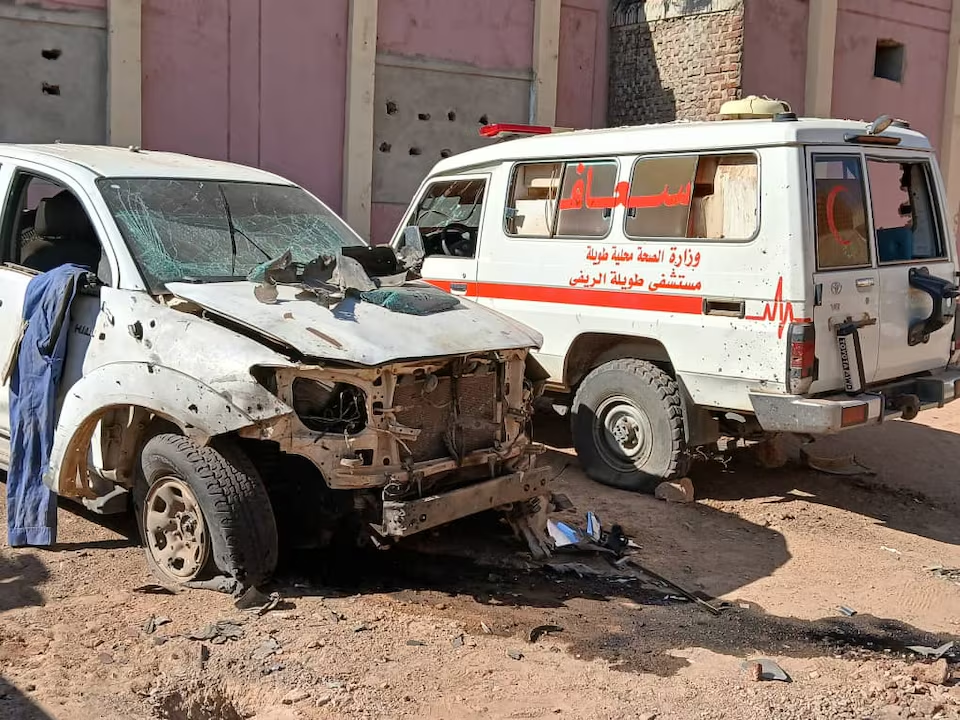
Image 2. Damaged ambulances at Saudi Hospital in Al-Fashir due to bombing in December 2024
Source: Reuters
Survival, in these contexts, does not often translate into an end to all effects of violence. In its place, it brings victims to the following phase, whether that be the psychological toll or the physical consequences latched on to them.
In the two wars, this lingering is realized, where systems designed to receive and tend to scars are deliberately crushed. In Sudan, RSF forcefully entered Al-Saudi Maternity Hospital, a sanctuary where reproductive care should have been at the forefront of reception, killing 460 patients and companions (Reuters, 2025). In its wake, more than 6,000 pregnant women were left without access to any medical or reproductive health service, among them women who had survived sexual violence and now had nowhere to seek treatment (UNFPA, 2025).
The Democratic Republic of Congo shows a slower version of a similar collapse. As of May 2025, only 7 of North Kivu’s 34 health zones held even a small amount of stock for post-rape kits, and only 13 percent of rape survivors received post-exposure prophylaxis within the critical 72-hour window.
With this, we see conditions as critical as the possibility of recovery rendered impossible, intentionally, by those incentivised toward destruction, and unintentionally, by the unforgiving limits of time and funds, and victims in Congo and Sudan are left to question, threadbare: What then? What do they do now?
Protectors Who Become Perpetuators
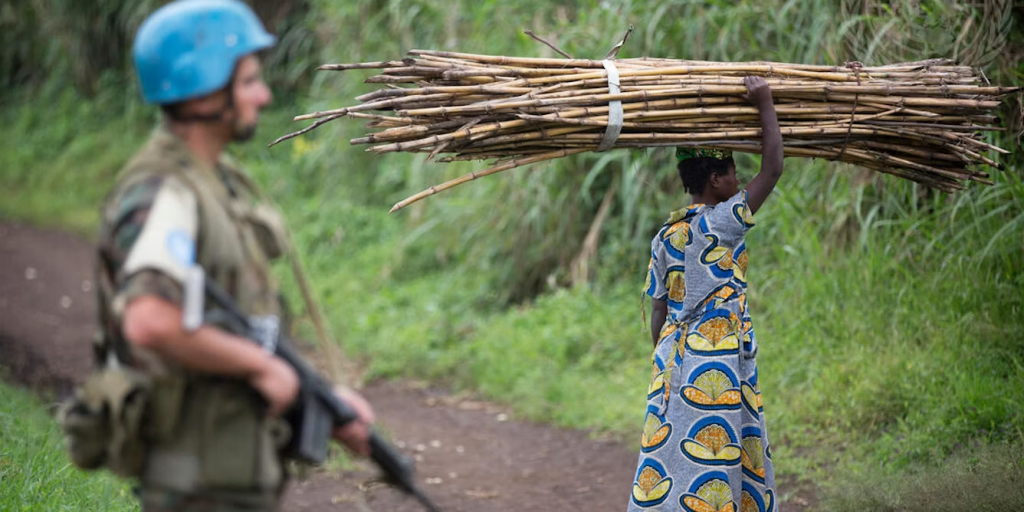
Image 3. A UN peacekeeper patrols the Beni region of the eastern DRC while a resident gathers wood in 2014.
Source: UN Photo/Sylvain Liechti
The destruction of hospitals and care is not the extent to which the violent cycle repeats. In both the Democratic Republic of Congo and Sudan, sexual abuse has been perpetrated by members of the very institutions mandated to interrupt this violence: Peacekeepers and alike. In Darfur, UNAMID disclosed that a national civilian staff member, arrested in November 2017 on charges of sexually offending a 13-year-old girl, was found guilty of her rape in May 2019. (UNAMID, 2019).
The Democratic Republic of Congo, similarly, currently holds the highest number of peacekeeper-perpetrated sexual abuse cases of any country in the world, roughly a third of all such allegations recorded globally. Researchers note that the present pattern is one enabled by mass displacement, extreme poverty, and judicial systems too weak to hold anyone accountable (The Conversation, 2024).
The aftermath becomes the primary devastating distinction from the violence described at the beginning of this article. Of the 188 paternity claims filed against peacekeepers in DRC since 2010, only 21 have ever been validated, leaving most mothers and children with empty acknowledgements (The New Humanitarian, 2024). A mother, among the victims, confessed to the weight and struggle of it all plainly: “I sometimes wonder whether I should kill myself or my child, but I guess I just need to hold on and bear the consequences of my decisions.” (The Conversation, 2024).
What remains is a bitter and rotten aftertaste, where no institutional accountability is present to support abandoned mothers and children. What is left is mere repatriation, where the accused and convicted are simply addressed by their removal from duty, by their being sent home to fulfil standard procedure. There is no prosecution or compensation for the life that these noble agents have stolen, there is no answer for the fatherless children, there is no resolution for the insults and shame mothers, victims, face every day, coming from as close as family bound by blood.
Breaking the Cycle?
Sudan and the Democratic Republic of Congo are not the only places this cycle exists, but they are, at this moment, where it is most visible, where it is etched and embedded with incomprehensible violence exposed to the world. They present and evoke outcomes with such perceivable inevitability that pessimism becomes the only emotion people feel when confronted with them.
However, this article does not exist to carry the rivers of hopelessness forward. Far from it, the identification of this cycle exists to emphasise that this is in fact not inevitable, that this is not incurable, that identifying the issue proposes hope for a liberated tomorrow for the women of Sudan and Congo, so long as this identification is followed with institutional accountability. That post-rape care can be funded and staffed with the same urgency as battlefield artillery. That peacekeeping accountability can be redesigned so that repatriation marks the beginning of justice, not its quiet retreat.
What we opened with remains true: violence does not finish when the act has been carried out. But neither does the obligation to respond to it. This cycle persists because each step leading to it, the assault, the empty clinic, the peacekeeper sent quietly home, has been treated as isolated failures than one continuous structure, all accountable in the reinforcements of each other.
Naming the structure will certainly not break this cycle; it is all that it is, naming. But one thing is certain, it refuses to let the silence be the only thing left for it.
REFERENCES
Al Jazeera. (2025, December 12). Rights group accuses RSF of systematic sexual violence in Sudan’s civil war. https://www.aljazeera.com/news/2025/12/12/rights-group-accuses-rsf-of-systematic-sexual-violence-in-sudans-civil-war
Al Jazeera. (2026, February 19). UN mission finds RSF destruction in El-Fasher bears ‘hallmarks of genocide’. https://www.aljazeera.com/news/2026/2/19/un-mission-finds-rsf-destruction-in-el-fasher-bears-hallmarks-of-genocide
Global Press Journal. (2024, February 12). 25 Years, 224 Abuse Allegations, No Peace: A Timeline of the UN Peacekeeping Mission in DRC. https://globalpressjournal.com/africa/democratic-republic-of-congo/25-years-224-abuse-allegations-no-peace-drc-kicks-un-peacekeeping-mission/
McGreal, C. (2008, December 5). Rape used as weapon of war in DRC. https://www.theguardian.com/world/2008/dec/05/congo-women
Mollica, R. F. (2006). Healing invisible wounds: Paths to hope and recovery in a violent world. Harcourt.
Office of the United Nations High Commissioner for Human Rights (OHCHR). (2025, November 7). Sudan: UN experts appalled by reports of mass atrocities, unlawful killings and sexual violence in El Fasher, https://www.ohchr.org/en/press-releases/2025/11/sudan-un-experts-appalled-reports-mass-atrocities-unlawful-killings-and
Reid-Cunningham, A. R. (2008). Rape as a weapon of genocide. Genocide Studies and Prevention, 3(3), 279–296. doi.org
Reuters. (2025, November 28). Hospital massacre caps a long series of attacks on healthcare in war-torn Sudan. https://www.reuters.com/world/sudan-hospital-massacre-is-latest-example-an-increasingly-brutal-war-strategy-2025-11-28/
Sudan Tribune. (2025, July 29). Sudanese doctors say 135 rape victims died by suicide since war began. https://sudantribune.com/article/303384
The Conversation. (2022, August 9). Sexual exploitation by UN peacekeepers in DRC: Fatherless children speak for first time about the pain of being abandoned. https://theconversation.com/sexual-exploitation-by-un-peacekeepers-in-drc-fatherless-children-speak-for-first-time-about-the-pain-of-being-abandoned-188248
The New Humanitarian. (2024, September 25). In DR Congo’s Beni region, departing peacekeepers leave a trail of abuse and anger. https://www.thenewhumanitarian.org/news-feature/2024/09/24/drc-beni-region-departing-un-monusco-peacekeepers-leave-trail-abuse-anger
United Nations. (2014, March). Backgrounder: Sexual violence as a weapon of war. Outreach Programme on the Rwanda Genocide and the United Nations. www.un.org/en/preventgenocide/rwanda/assets/pdf/Backgrounder%20Sexual%20Violence%202014.pdf.
United Nations Mission in Darfur (UNAMID). (2019, July 1). Allegations of Sexual Offences by a UNAMID National Civilian Staff. https://unamid.unmissions.org/en/news/allegations-sexual-offences-unamid-national-civilian-staff-0
United Nations News. (2025, April). Sexual violence systematically used as a weapon of war in the DR Congo. https://news.un.org/en/story/2025/04/1162536
United Nations Population Fund (UNFPA). (2025, October 28). Flash update on the situation in El Fasher, Sudan. https://www.unfpa.org/resources/flash-update-situation-el-fasher-sudan-october-28-2025
United Nations Population Fund (UNFPA). (2025, July 16). Democratic Republic of Congo Situation Report – May 2025. https://www.unfpa.org/sites/default/files/resource-pdf/UNFPA%20DRC_Sitrep_May.pdf

0 Comments