[ISAFIS News #18] US-Iran Peace Negotiation Faces a Treacherous Road
Written by: Jonathan Jordan Manager of Writings
After more than three months of war, the United States (US) and Iran have agreed to a memorandum of understanding (MoU) signed on June 17, 2026 that serves as a stepping stone for further peace negotiations. However, its implementation has proven shaky as US President Donald Trump continues to threaten Iran and Israel’s war against Hezbollah in Lebanon serves as a flashpoint that could prevent lasting peace.
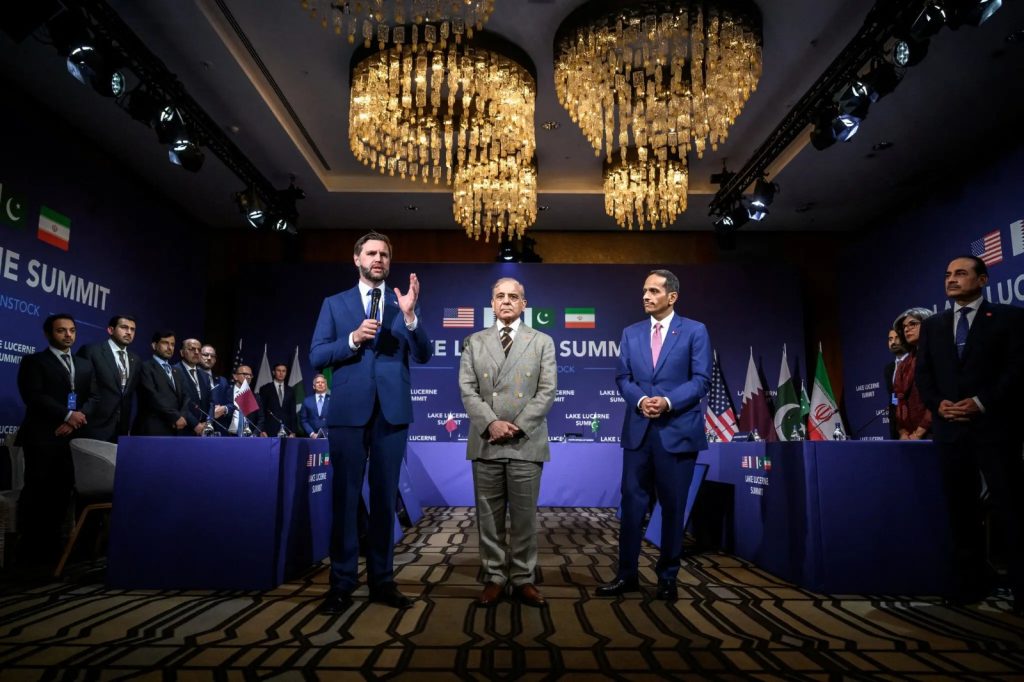
Image 1. United States Vice President JD Vance (left) next to Prime Minister Shebaz Sharif of Pakistan (center) and Sheikh Mohammed bin Abdulrahman al-Thani of Qatar at the Bürgenstock resort, Switzerland, on June 21, 2026 for talks with Iran
Source: Fabrice Coffrini
With the help of Qatari and Pakistani mediation, the US and Iran agreed to an MoU as a step to end war between both states on June 15, 2026. Two days later, leaders from both countries officially signed the agreement electronically. The MoU outlines a 60-day period for further talks that will lead to a permanent peace.
The document states that both sides of the conflict are to cease hostilities at all fronts, including Lebanon. Besides that, Iran is to receive US$300 million for reconstruction, lifting of sanctions and naval blockade by the US, and access to its frozen overseas assets worth US$24 billion in exchange for free passage through the Strait of Hormuz and a commitment not to develop nuclear weapons, but allowed to use nuclear energy. Details on the sensitive nuclear issue are sidelined for future negotiations. Many analysts see this MoU as a victory for Tehran.
After the signing of the MoU, further talks between the US and Iran were scheduled to take place at the Bürgenstock resort, Switzerland on Friday, June 19. However, it was postponed to Monday the next week. The quadrilateral meeting between the US and Iran mediated by Qatar and Pakistan resulted in what officials claimed to be major progress. Both sides agreed to a roadmap for the 60-day negotiations, the establishment of direct communication lines to avoid “incidents and miscommunication”, commitment to ensure safe passage through the Strait of Hormuz, and progress to end fighting in Lebanon.
However, the road to peace is still filled with obstacles threatening to derail negotiations. The fighting in Lebanon is especially vulnerable to escalation. Despite the MoU, Israel still launched attacks in Lebanon in the same week—a form of protest to a deal it perceives to disregard its interests. Iran responded on Saturday by stating that it had closed the Strait of Hormuz despite the US claiming that passage is still open the next day. Despite Israel’s and Hezbollah’s agreement to halt fighting, tension still remains and could descend to further conflict.
President Trump also caused a rift between both Washington and Tehran by claiming that he could do whatever he wants, including bombing Iran. This has caused negotiations to stall as the Iranian delegation walked out early and refused to have a direct meeting with the US delegation on Monday.
War broke out on February 30 when Israel and the US launched a strike against Iran that killed among others Supreme Leader Ali Khamenei. This caused Iran to close the Strait of Hormuz, a vital chokepoint for energy trade, which has stoked a worldwide crisis.
References
Green, E. L., Kanno-Youngs, Z., Fasshihi, F., & Levenson, M. (2026, June 17). Trump Defends Deal to End the War With Iran as Details Emerge. The New York Times. https://www.nytimes.com/2026/06/17/world/middleeast/trump-iran-deal-obama.html
MacFarquhar, N. (2026, June 21). What Changed After Almost Four Months of War? Analysts Say Not Much. The New York Times. https://www.nytimes.com/2026/06/21/us/iran-us-peace-deal-nuclear-program-threats.html
Mada, K. (2026, June 18). AS-Iran Sama-sama Membayar Mahal Perdamaian. Kompas. https://www.kompas.id/artikel/as-iran-sama-sama-membayar-mahal-perdamaian
The New York Times. (2026a, June 20). A Look at the Text of the Agreement Between the United States and Iran. https://www.nytimes.com/2026/06/17/us/politics/us-iran-agreement-deal-text.html
The New York Times. (2026b, June 20). U.S. Details Agreement With Iran as Trump Departs G7 Summit. https://www.nytimes.com/live/2026/06/17/world/g7-summit-trump-france
The New York Times. (2026c, June 22). First Round of U.S.-Iran Talks Concludes, Mediators Say. https://www.nytimes.com/live/2026/06/21/world/iran-us-trump-lebanon
The New York Times. (2026d, June 22). Oil Prices Fall as U.S.-Iran Talks Show Signs of Progress. https://www.nytimes.com/2026/06/22/business/oil-gas-price-iran.html
Rasgon, A., Bergman, R., Fassihi, F., Sanger, D. E., Peltier, E., Troianovski, A. (2026, June 17). How the U.S.-Iran Deal Came Down to the Wire. The New York Times. https://www.nytimes.com/2026/06/17/us/politics/us-iran-deal-trump.html
Saleh, N. (2026, June 17). Titik Temu Iran-Amerika. Tempo. https://www.tempo.co/internasional/kesepakatan-iran-amerika-akhiri-perang-2269702
Sanger, D. E. (2026, June 17). Trump Demanded Iran’s ‘Unconditional Surrender.’ He Got a Surprise Instead. The New York Times. https://www.nytimes.com/2026/06/17/us/politics/trump-iran-deal-nuclear-program-strait.html
Sarwindaningrum, I. (2026, June 22). Pembicaraan AS-Iran Terhambat karena Ancaman Trump dan Serangan Israel. Kompas. https://www.kompas.id/artikel/pembicaraan-as-iran-macet-karena-ancaman-trump-dan-serangan-israel
Tankersley, J. (2026, June 19). Swiss Officials Say Iran Talks Are Off, for Now. The New York Times. https://www.nytimes.com/2026/06/19/world/europe/switzerland-iran-talks.html
Tarigan, M. (2026, June 17). Tantangan Setelah Amerika dan Iran Sepakat Mengakhiri Perang. Tempo. https://www.tempo.co/internasional/perdamaian-amerika-iran-akhir-perang-2269700

0 Comments