[ISAFIS News #17] China Prioritizes Authority of the UN Charter as Security Council’s President for May 2026
Written by: Flicka Miracle Simarmata Staff of Research and Discussion
Upon taking the presidency of the United Nations Security Council this May, China has called for a renewed commitment to the foundational principles of the United Nations Charter, prioritizing sovereign equality and a UN-centered international order amidst heightened global tensions. This rotation of the presidency happens every month, where the UNSC follows a strict change, rotating across the 15 members in alphabetical order of their official English names. This is done to ensure equality of agenda-setting influence amongst all members, permanent or not.
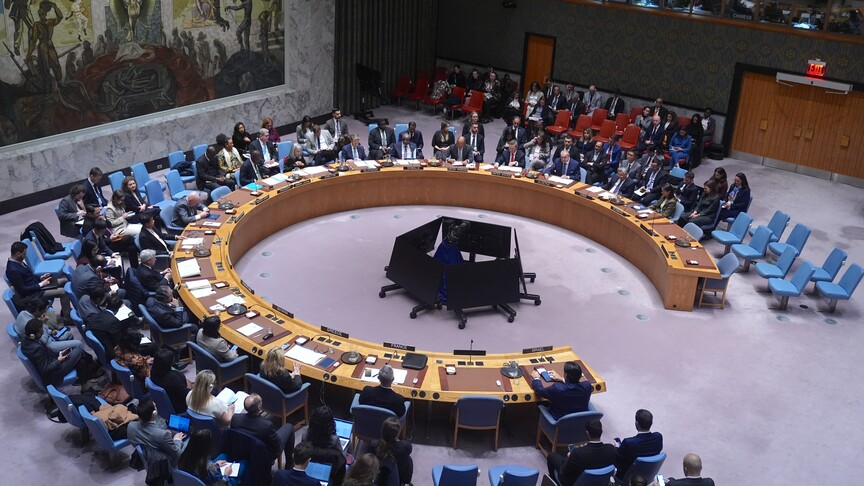
Image 1. A United Nations Security Council meeting
Source: Anadolu Agency
But what makes May’s presidential rotation different? As China assumes the role as president of the Security Council earlier this month, we see a moment where geopolitics is at its highest stake. As one of the 5 permanent members (P5) with veto-wielding powers, their role as president can turn the tide and use its presidency to strategically steer the narrative of global security at a time when the post-Cold War international system is facing unprecedented strain.
As many consider China to be a global superpower, a country with extreme power and resources to tackle others, people would assume they would use this position to their advantage. However, they have begun to build their presidency strictly around upholding the United Nations Charter, staying realistic by only focusing on certain chapters.
Chapter I, article 2 of the charter reads, “The Organization is based on the principle of the sovereign equality of all its Members.” This is their primary weapon against a unipolar world order. China uses this article to argue that international rules should not be dictated by exclusive coalitions (like the G7 or NATO). And in his May briefings, Ambassador Fu Cong repeatedly stressed that the international system must be “UN-centered,” implying that a small club of Western nations has no right to establish a “rules-based order” outside of the equal framework guaranteed to all 193 UN members.
Beyond specific articles, China’s presidency heavily emphasizes on the Charter’s origin story. Ambassador Fu Cong explicitly noted that they have planned a ministerial-level open debate on May 26th, which is to be chaired directly by Chinese foreign minister Wang Yi. It is aimed to “safeguard the victorious outcomes of World War II”.
Triggered by long-standing geopolitical friction, including Trump-era unilateral treaty exits and current maritime standoffs, China’s presidency underscores a deeply divided global order. Official Beijing briefings state that championing the UN Charter protects a “UN-centered system” and sovereign equality for developing nations. Conversely, Western international relations analysts interpret this focus as a calculated effort to undermine Western security frameworks and shield sovereign governments from external human rights accountability.
References
Banjo, D. (2026, May 5). How China Is Winning at the UN Without Even Trying. PassBlue. https://passblue.com/2026/05/04/how-china-is-winning-at-the-un-without-even-trying/
CGTN. (2026, May 2). China sets out UN Security Council priorities as presidency begins. https://news.cgtn.com/news/2026-05-02/China-sets-out-UN-Security-Council-priorities-as-presidency-begins-1MOBd4T0noA/index.html
Security Council Report. (2026). Monthly Forecast May 2026. https://www.securitycouncilreport.org/monthly-forecast/2026-05/upholding-the-un-charter.php
U.N. Charter art. 2, para. 2.
United Nations. (2026, May 2). China: President of the Security Council for the month of May 2026 -Press Conference |United Nations [Video]. YouTube. https://www.youtube.com/watch?v=789aARC7mKU
United Nations Security Council. (n.d.). Security Council Presidency. https://main.un.org/securitycouncil/en/content/presidency

0 Comments